


Design an engaging learning experience for teenagers and students
2018. UULA is Kuwait-based edTech startup with 50-200 employees and over 300,000 daily users.
Challenges and goalsDesign an engaging learning experience for teenagers and students
Online education is quite a competitive market. Global educational platforms such as Udemy, Duolingo and others, already have their own audience in Kuwait. UULA has also been presented in 🇰🇼 Kuwait, but only as a web-app. Our goal was to create an iOS App that would make education appealing, activate teens and their parents, and engage them in the long-term.
Measuring success- Metrics that measured how valuable the app would be:
- Daily Active Users / Weekly Active Users
- Percentage of students moving from web to mobile app
- Percentage of students with finished courses
- Amount of finished courses and passed tests
- App Store feedbacks
Coordinate all design initiatives
I coordinated design initiatives at UULA, including user research processes, defining personas, creating prototypes, setting requirements for data collection, improving cross-functional communications, generating hypothesis.
Design processLeveraging qualitative and quantitative insights
I explored web application usage data from analytics and questions from the intercom. No one on our team spoke Arabic, so we prepared a list of questions for user interviews to pass them to the founder. So, founder assistants helped us run user interviews. We outlined a set of personas and user journey maps, and pain points of the process before the iOS App development started. As a result, we decided to remove the parent role and all related workflows from the MVP.


Said, 10 years. Lives in Kuwait
Behavior
Parents bought the course package. Most of the time, he plays on the phone. He studies on the computer.
Needs and GoalsHe has low motivation (for goodies). He does not always understand why he needs to do it. He wants to get to the next level in the courses or to comply with the agreements with the parents.


Zaida, 16 years. Lives in Saudi Arabia
Behavior
She passed all free parts of courses. She has bought only the necessary courses for the upcoming exams. Parents decide to buy a subscription or not.
Needs and GoalsStrong motivation, wants to pass entrance exams in his country or another country's Universities. She wants to gain new knowledge and be ready for the entry exams.


Samad, 22 years. Lives in Kuwait
Behavior
He studies at university, uses his mobile phone for education on UULA. He decides whether to buy a subscription or not.
Needs and GoalsNot too motivated. He wants to improve his knowledge in some subjects, because he does not always have time to attend classes.
Scoping a minimal viable product
Workflows that would enable us to test our hypotheses
I explored core workflows for user stories based on the web app. We tried to pare it down to the most essential workflows for an MVP.
- As a student, I want to be able to access courses anywhere.
- As a student, I want to be able to access all the assets from courses.
- As a student, I want to see all my progress and subscriptions from a web app.
As a parent, I want to view my child's education progress inside the app.As a parent, I want to buy a course on a mobile app.
I have developed a provisional IA.


Prototype
Putting ideas into action
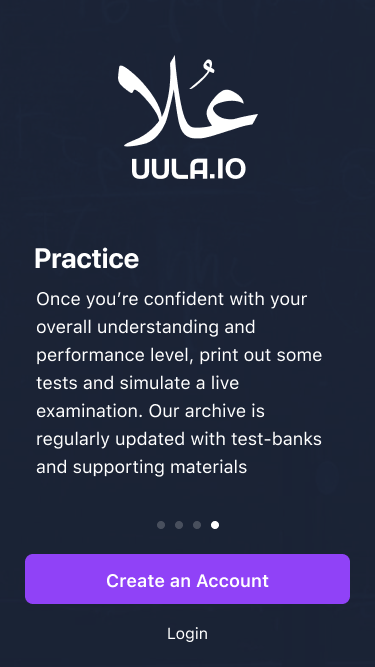
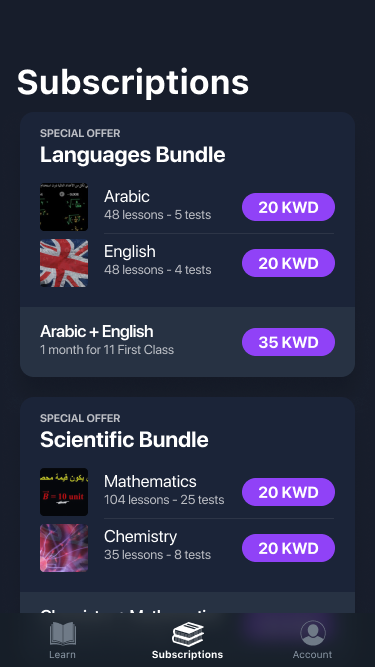
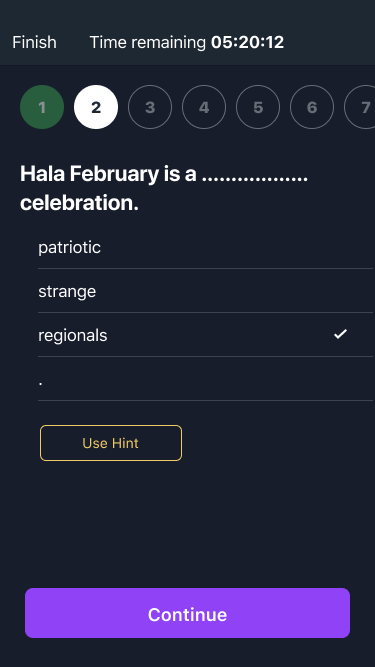
No web app design artifacts, no brand guidelines, and no time to build it from scratch... How to avoid chaos during the prototyping? The simplest solution is to use Figma Library iOS UI Kit and follow Apple Human Interface Guidelines. So we started prototyping based on native iOS components and adding new ones to the UI Kit.
Thus, we start using native iOS components, but in the dark theme. And yes... we designed a dark theme 1 year before the Apple presentation, just because we tried to be consistent with the web app.


Each node of IA ideally fits to the tab bars. In general, the draft structure of the application was already clear.
Each course has a multilevel tree structure, and there is no such native pattern on iOS. Later, we converted course tree into 3 screens


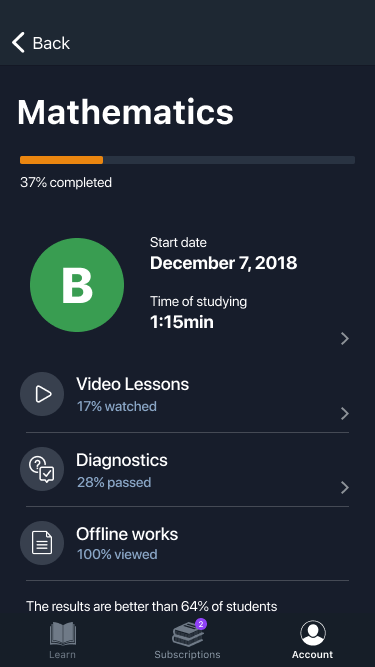
I've added goblets, something like gamification in the cheap way. Students see gold, silver, or bronze goblets because of good assessments. One more thing, the app shows comparable results with other students for the subject. These comparable results allow parents and students to track progress among peers.
A measurable impact after launch
- ✅ DAU/WAU increased across all platforms
- ✅ Audience of mobile app reached our goal
- ✅ Increased percentage of students with finished courses, but not too much
- ✅ Increased number of finished courses and passed tests, but not too much
- ⭐ Upper more than 4.5 Review rate from start and we not asked to write
I'm proud of the work our team has achieved in such a short period. I'm proud of the external dev team which made this product become a reality.
Updates after launchFurther exploration
✅ One of my suggestions was comments for topics. After implementation of the comments, DAU increased.
✅ We changed the logic of fast-track visibility. The fast-track feature is available on the web-app after the purchase of the course. I've suggested making it visible all the time in the iOS App. This change helped increase the number of paid subscriptions.
I enjoy watching how UULA unlocks the future of education in the Middle East and helped teens be on track during the COVID-19 period.